I want to return ...

He wasn't an envoy sent by Tony Blair, nor by Prince Charles, and not even a businessman from Chelsea, or from those rock dinosaurs Rod Stewart or Paul McCartney. Not even an anglican missionary. Andy Jefferson is a typical Englishman that arrived in Peru in July 2010, not only to see Machu Picchu, Lake Titicaca, Colca, Nazca, Chan Chan, and Huaraz, but also especially to visit Marcahuasi.
Andy Jefferson - "The Lord" 

We go to Marcahuasi, with the same motivation as always, but the journey is a series of surprises. The silence of Andy, was like some of the immense abysses that we travel past, or like the monotonous noise of the buses that took us there. I don't know if he had his emotions imprisoned, but from his mouth we had no expression of complaint or euphoria. I only know that the heat of the sacred mountain grew more and more, and the adventurers rucksack he brought from England was full of questions for this meeting in Marcahuasi.

San Pedro Casta lives the national holidays to the rhythm of the arrival of the tourists, the square full of backpackers, similarly the tourist office, and the loudspeakers repeated : "Please community, we need 2 horses, and 4 donkeys ..."
I see no red bus! There's no Big Ben around here! Where am I ? 
No Andy, you're in San Pedro de Casta we told him "Ah, ok, ok!" 

Andy, in one glance, took in and grasped this madness of the call to Marcahuasi. But he continued silent, not asking anything, just accepting what was passing around him, cold like the bitter winters of his land, and cold of another sort was waiting for us in the amphitheatre.

We left the town very late, because Ysrael and Carlos wanted it like this! [editor : because they arrived late]. The route varied with everything that it handed to us ... the route of portachuelo (long track). Andy took the lead, and nobody in the group passed him, his pains, his tiredness, and his ... only he knew what. We arrived at the "marcahuasi hotel" by night, full of backpackers, full of shouting ... I don't know if it was of happiness, of pain, or of madness.

"With every experience there is suffering, and for any suffering there is something good later on". This is what Andy said when he had removed the burden of the ascent.

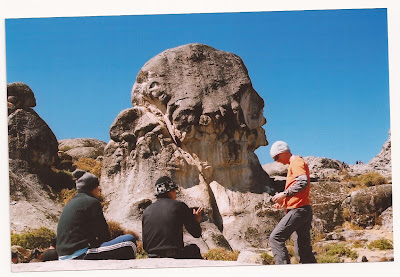
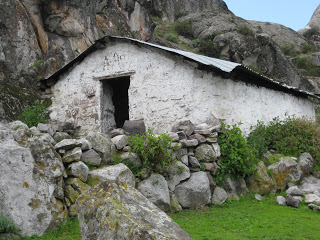
The next day, between jokes and laughs, we prepared the "brunch", and then we headed to the ruins of Huacracocha and the hut, where the Monument to Humanity waited for us. A sculpture that silenced Andy even more, his appreciation was censured; I think he asked and they responded in silence.
He said, "Uuuuuuhhhh, y ..." and then stayed quiet, petrified like the shout of this mysterious cyclops. 

Then we walked via the Lake of Huacracocha and the cliffs, cliffs that filled Andy with fear, like an English joke ... nobody understands it ... perhaps in his country they remember that cliffs are a place to fill you full of emotions and questions.

"Marcahuasi is different for everybody. It's a place of discovery" (Andy) We returned to the amphitheatre tired, thirsty and hungry. We cooked rice, with onion and tuna ... and also cooked our ideas and theories of what is, and was, Marcahuasi.

When the night invades the amphitheatre, when the inner warming starts to have an effect, the bonfires start to surrender to the cold, Andy, forgetting for an instant his origins, and we are reminded of Jose Antonio, Jose Antonio of the beautiful Chabuca Granda, and we finish the night off with a salsa of Grupo Niche, singing and dancing ... that, that's it, cheers Andy. That is the westerner we wanted to see ...

"I liked spending a night in the amphitheatre" affirmed Andy.

We still needed to got to Cachu Cachu and the Fortress, so that's where we went. The journey was seasoned with photos and lots of enthusiasm, when we arrived at the fortress, "This is a place with significant mystery, who lived here, and why, there was sufficient defence back in the fortress, no?" For something? Andy made this immense question in that blanket of mystery and silence. This lives and hides in Marcahuasi.

We returned to the amphitheatre to recover, and spend our last night, a night full of conversation, of music and singing. There we met Marco Antonio, a friend of these altitudes, a type of free paparazzi, self-styled searcher for UFOs.

To end the trip to the sacred mountain, Andy left these reflections about San Pedro de Casta, Marcahuasi and the tourists :
- "I believe that San Pedro de Casta ought to do much much more to attract and cater for tourism, in books, and tourist guides of Marcahuasi there is very little information to see all of these sculptures, at the most appropriate time of day etc"
- "Marcahuasi, for me, has it's place with a deep mystery in its rocks and ruins ..."
- "There was a lot of rubbish left by tourists, some caring for Marcahuasi, but others not. Some with a lack of respect for this sacred place".
- "Who can solve the insatisfaction of the tourist, the lack of information?" Asked several times on the plateau.

"Sat in the amphitheatre, if you look down, at the ground or at some point a short distance away, but not fixedly, relax yourself and your muscles, you can see air currents, or something of that form, ... only if you relax completely and let the moment take you, air currents? or something similar. The important thing is I saw them, and felt it"
Our English medium affirmed it like this. Must be true, no? 

Andy returned to his country on the 17th of September, perhaps missing his steak with "English-style egg" (half raw) [editor : a peruvian belief that people in England eat half cooked eggs, God knows where they got that idea], but left with the promise to return and perhaps compromise himself with some of his reflections. In Marcahuasi, the law of giving and receiving is important. Andy, that the sacred mountain has captivated you with its mysteries, and they will accompany you, as Marcahuasi demands.

"I feel nostalgic for Marcahuasi - I want to return"

You have to look at both sides of the equation; the national tourists, and the foreign tourists. Of the believers and the non-believers of the Marcahuasi mystery. Of those that go up a single time, and those that return continually. Andy's visit, like that of many others that came or will come from afar, is valient, and these are the primary free diffusors of the sacred mountains significance. For that it's great to share our knowledge of Marcahuasi, and with all of those that arrive at the plateau, to not only admire it, but also to make it your own. It's the case of Patricio Marambio (Chile), Alan Mathew (USA), Peter Schneider (Switzerland), and many others that have no problem in identifiy themselves with Marcahuasi.

Thanks Andy Jefferson, for the diffusion that you do for Marcahuasi, and for allowing me to write of your visit, of many silences, and surprises; surprises for the delight of this backpacker world of Marcahuasi.

Photos from the experience
-Andy and the mystical cross
"Here on the mystical cross I felt a tremble en my hands - there was something - I'm sure of it -" said Andy, after the ritual of concentration and meditation.


"There are many interesting places, especially the Monument to Humanity, the fortress, the chulpas and the lake of Cachu Cachu" the English lord emphasized.


"Another hot drink?" - "Yes, thanks..." replied andy - "It's Marcahuasi tea" -replied Marco Antonio. "Ok, it's good, just like the tea from my country" - said Andy.


-Andy and Carlos ... washing plates with the water ....
"Save the water Andy, or do you want to go down and bring more back up again?" - advised Carlos, "For me that wouldn't be a problem, whereas for you, I think it may be more difficult gordito..."


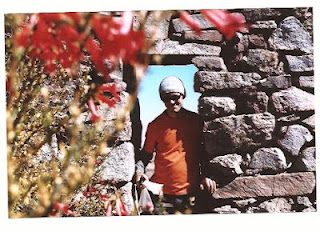
- Andy and the Huacracocha ruins ...
The chulpa ruins of this necropolis of Huacracocha were something that he liked a lot, but demanded their preservation, and more respect from those who visit them.


Next Post: Graffiti in Marcahuasi
Photos: John Ysrael Guevara
Foreign Writers and Marcahuasi

It isn't as simple as just trawling through the books of Erich Von Daniken, Rodolfo Benavides, Charles Berlitz and Peter Kolosimo. These writers gave a lot about their investigations and publications that, despite their age, continue under the classification of esoteric, unexplainable mysteries, disappeared civilizations, mysticism, and the presence of extraterrestrials on Earth; topics that hold us hostage due to the mystery of the unknown. In many works these writers do however mention Marcahuasi.

From August 1952, when Daniel Ruzo travelled to the plateau of Marcahuasi for the first time, he described this place throughout Peru and in many parts of the world through conferences, and in leaflets and books written by this pioneer of the plateau. Due to this diffusion of information, many foreign writers mentioned Marcahuasi in their books.

The Mexican writer Rodolfo Benavides, in his book "Dramatic prophecies of the big pyramid" (34th edition), in page 33, "chapter II - The fantastic that is confused with the real" says
"In the altiplano of Marcahuasi, in the peaks of the Andes at 3800m above sea level, there are figures of humans and animals (some the predecesors of mammals) sculpted into the rocks, corresponding to the second age. And not just that, there are also statues of lions, camels and tortoise. All of that, in a context where they believed that such species were unknown in America. It has been impossible to say the age of these monuments by carbon(14) dating*."

* Carbon(14) dating is a method designed to determine the age of rock, though not the only method known.


They mention in their books that in the plateau of Marcahuasi there are lions, camels, tortoise and elephants. Why don't they publish photos?


Erich Von Daniken, polemic and well-discussed writer about the extraterrestrial phenomenon, in his book "Memories for the future" on page 123 says "At an altitude of 3800 metres above sea level, in some rocks of the deserted plateau of Marcahuasi they found some drawings of animals that didn't exist in South America 10000 years ago; camels and lions"*

* The information about Marcahuasi is here in the petrified sculptures, Mr Daniken, you still have the opportunity to grapple with this mystery, "we await you".

The Monument to Humanity, the principle sculpture on the plateau, and they don't mention it. The sculptures of animals and humans are of the same age!

"Memories for the future" was published in more than 44 editions and in different languages, mentioning that they found "drawings" in Marcahuasi, an error that not even the aliens would forgive. In other books by the same author he mentions the sacred mountain.

In 1979 Charles Berlitz published the book "The Bermuda Triangle"; an investigator of UFOs and mysteries, and often criticized for this book. On page 223 of the book, chapter 8 "Surprises of the prehistoric" cites "In the plateau of Marcahuasi, near Kenko, Peru. There are huge rock workings, and in some cases there are slopes that have been changed by the carvings. The preincan works, despite finding themselves crumbling from uncountable centuries, can be identified as lions, horses, camels and elephants, none of which are known to have existed during the ages of civilisation in South America".

Millions of people that read "The Bermuda Triangle" have erroneous information due to Charles Berlitz, by writing that Marcahuasi is found "near Kenko" (Cuzco)! There is a property called Marcahuasi, in the district of Mollepata (province of Anta) with Inca ruins, but there are no carvings of lions, horses, camels or elephants!


The book "Spaceships in Pre-history" by the journalist Peter Kolosimo, that in the 1970s was a revelation for his investigations, publications and exploring of the mysteries, in page 92 chapter III "The children of the moon" writes this of Marcahuasi :
"In Marcahuasi, the enigmatic deserted plateau, at an altitude of 3800 metres in Peru, at the west of the Andes mountain chain, Daniel Ruzo has found sculptures that represent extinct species that lived up from 195 to 130 millions of years ago, figures of elephants, oxen, and horses, animals that didn't exist in America in the times of Christopher Columbus' discovery."


Anfichelidia, as it was named by Daniel Ruzo, an animal that disappeared thousand of years ago, but not millions. You can find it near the five lakes.

To cite that Marcahuasi lies to the west of the Andes mountain range, knowing that this goes from the south to the north of Peru, lacks precision and that Daniel Ruzo found extinct species that lived 195 to 130 millions of years ago is nothing fantastic, not even a millionaires realism. Rest in peace, in some spaceship Peter Kolosimo.


The plateau of Marcahuasi is located in the district of San Pedro de Casta, in the province of Huarochiri, 90 kilometres east of Lima, the Peruvian capital. It is at an altitude of 4000 metres above sea level. Charles Berlitz ... please inform yourself, in the next life!

There are many foreign writers that mention Marcahuasi, like Jacques Bergier, Louis Powell, Reais Pire etc, but they don't go further than the well known fact. Consequently the sacred mountain continues being a mystery, and the reader continues seeing through a small Peruvian hole a series of sculptures that survive the inclemencies of the weather, defying human intelligence.

Daniel Ruzo, in his book "Marcahuasi, the fantastic history of a discovery" (the Marcahuasian bible) thanks Jacques Bergier, Louis Powell for the praise that they heaped on him in their books. But what of the other writers ?

Rodolfo Benavides, Erich Von Daniken, Charles Berlitz and Peter Kolosimo, ... lovers of mystery, disappeared civilisations, and the presence of aliens on earth, ... they all need to become reconciled with the petrified forest for writing about Marcahuasi without even having visited it! Knowing, as they do, that here the mystery is so strong. What happened? without them all being explorers of ... of what exactly? Didn't they want to visit, or weren't they able, or was it the ambition to publish book after book with titles that are each time more suggestive, they got confused in the nebula of their own vested interests.


We arrive at Marcahuasi in search of "something", and we return without knowing why. This photography, that the writers of the mystery ignored, and Ruzo never saw, but he did predict it.

The truth is that these authors published millions of books, in many languages, with citations about Marcahuasi and about Daniel Ruzo, but they never made any observation of their own. Why was that?

Conclusion : There is so much charm and so much mystery in Marcahuasi and they wrote nothing of note, just a citation re-worded or cloned.


Next Post: An English "Lord" in Marcahuasi.
Photos : John Ysrael Guevara

An ex-President and I in Marcahuasi

I've still not digested totally the coup of the 5th of April 1992. Similarly I've still don't understand totally the acts of the terrorists, military forces, and the Peruvian government ... but I'm not going to write about that, but instead about my meeting with a Peruvian president on the 28th of June 1992 on the plateau in Marcahuasi.


The 90's was when I most visited the sacred mountain. I went up with the hope of meeting Daniel Ruzo, Rosario Olivas Weston or his sister Marcela, who I did actually meet. I never imagined I would find the Peruvian head of state.

San Pedro de Casta was ready to celebrate another anniversary, and the preparations for dancing, eating and drinking were well received by the happy people who arrived, and by the tourists also. Very few backpackers went up to the plateau and we were amongst the few. We camped in the Hut (of Ruzo) alone; when I say alone obviously we always had the company of the Monument to Humanity with us.

The day after (28th of June) I got up very early to take in some of the views near the Hut and, when the photographic search was over, we started to prepare a delicious breakfast-lunch, and then we went to rest alongside "the Chinese", "the Llama" and "the Soldier" (petrified sculptures) ...

This aircraft perhaps scared Soctacure and the Monument to Humanity. For us it raised the question "who is it?"


The morning was warm, clean and quiet. The astral god slowly warmed the rocks, the peace was infinite ... when suddenly we heard a noise that was growing, encircling the plateau. A rowdy noise that seemed to be nearing, and then leaving, or that is how it felt from the position where we found ourselves. The peace that Marcahuasi freely gifts us was broken.

"There!, there it is! It's a helicopter!" we shouted in unison, while it overflew the Hut and returned to the south of the plateau, repeating this several times. They gave us time to arm our cameras, and to ask "Who is it?"

The aircraft made many passes over the plateau, a new way to visit and to arrive at Marcahuasi, and to view it from the sky was a real privilege for whoever was aboard. I've seen the aerial photos of the plateau, published by Daniel Ruzo, but there are no photos of sculptures taken from above.

At one point I thought it may be some military mission, that possibly the terrorists had been in Marcahuasi. I believed also that it maybe was an informative exercise due to the parties of San Pedro de Casta. The thing I never expected was that this craft had aboard the Peruvian President!

After a short walk, past the tortoise and the African lions, the president prepared his food here. A few rocks and a top chef in Marcahuasi

After bathing Marcahuasi in that presidential noise, the helicopter was quietening, and started to descend and, to my amazement, was welcomed by "The Monkey", "The Monument to Humanity", "The Tortoise", and "The African Lion" ...

It is 10:30am and I left the place I was at, running to the Hut, and grabbed the recorder. These were instants that my periodistic sense of smell activated. I wanted to know who really had landed there.

I went down, just like someone returning to San Pedro de Casta, and the went up the path behind the tortoise, agitated. I don't know if I walked or ran, but to my amazement she stepped out of the shadows. In front of me was Sachi; of course I knew who she was. With this agitation typical of the altitude, I asked "do you think your father would give me an interview?". She looked at me for an instant, and said "of course, go ahead". The distance between her and the others was almost nothing, but was enough to organise my questions, and in that fight I was in front of 2 adults, 2 children and a spoilt dog.

"One goes sometimes to Marcahuasi, with wind behind you,
you meet good friends, beautiful sculptures ...
But on this occasion I met the Peruvian president.
A blessing from the mountain gods"


A welcome broke the protocols, and a forced presentation that Marcahuasi's silence only knows. Now relaxed, sat on the rocks, looking towards the Monument to Humanity, the cyclops that is most discussed in Marcahuasi. The president asked me point blank "to what medium do you belong". "To none. I'm writing about this place, because I find it very interesting" I replied.

The president, perhaps tired of questions and answers in the capital came here for refuge, without thinking that at 4000 metres of altitude I was waiting for him! I don't know if this meeting was work of the mountain gods, or a prize for my continual returns here. Whatever it was for, I was now interviewing the Peruvian president, Mr Alberto Kenji Fujimori Fujimori, at the sacred mountain on the eve of the San Pedro de Casta anniversary.


This photo marks the end of the interview, and an eternal memory that was lived in Marcahuasi. In this sense, the Monument to Humanity was witness to this meeting.

The complete interview with Alberto Fujimori will be published in my book.


Read the original post (in Spanish)

Next Post: Foreign Writers and Marcahuasi
Photos : John Ysrael Guevara

The Cliffs of Marcahuasi

I've no idea how they formed, nor when it happened, but there it is. The beautiful cliffs will be there, defeating time and our admiration.

These are lovely amazing scenes, in the morning, and better still when the sun is setting. They are an abyss to make us nervous, immense precipices that delight us right down to our being, that to be over them is to extract the mystery, the loneliness, the wind and the freedom.

We are anxious to know what is beyond the cliffs ... this is something that we ask ourselves every trip.


Extended rocks playing with the light ... waiting to crumble, unique cliffs without comparison, immobile and sleeping like angels or demons protecting the sacred mountain for millions of years.

Nobody looks for truth here - a magic game of shadows and sculptures.


How did these cliffs start? What happened here? Is this a punishment or a prize given to us by the plateau? Which theory should we believe? The esoteric? The mystic? The geological? or the extraterrestrial? All I know is that the cliffs signify a place to live and remember, to ask and ask.

We all arrive here, to enjoy the beauty of the cliffs, of the capricious cliffs, refugees, imprisoned and forgotten.

There is always a perfect instant to see something in Marcahuasi.


The majority of the sculptures that there are in Marcahuasi you will find near or within the cliffs, at the side of the plateau, besides which these precipices are very high that together with the rain, the clouds and the sun form beautiful landscapes that to contemplate is to enliven a strange happiness.

I have no proof to say how these monstrous petrified rocks rose, but they know how they arrived and when they will go, and while they exist they will continue enchanting us every time, a little more each time.

This is a picture made by the rain, the cliffs huddled wrapped in lichen, a landscape that paralyses the emotions.


To contemplate these cliffs we don't need the same language to understand each other, to be here is a constant motive, to be asphyxiated with admiration, because Marcahuasi always challenging us.

Who sculptured these rocks in Marcahuasi, here where time and space is everything and nothing. The cliffs are the formations of largest emotional impact, in a place where we need to protect the peace, where in every visit we consume the fruits of mystery, without losing sight of Marcahuasi as a whole.

Cliffs that divide the silence of the wilderness; to the visitors to Marcahuasi they will continue signifying the search for something.

Read the original post (in Spanish)

Next Post: An ex-President and I in Marcahuasi
Photos : John Ysrael Guevara

Interview : Manuel Olivares Bautista

"An inhabitant of San Pedro de Casta, loyal to Daniel Ruzo and Marcahuasi"

There are many reasons to interview Manuel, from San Pedro de Casta, who worked during 9 years alongside Daniel Ruzo in Marcahuasi. His experiences and his anecdotes keep on coming, never ending, and those of us that had the opportunity to travel with him to the plateau to get to know the petrified sculptures know what a privilege it is (was).

Tourists that arrive at his guest house, whether Peruvian or from further afield, can enjoy his stories, his emotions and sadnesses, but sadly it is now impossible for him to accompany us to climb up to the sacred mountain. His hearing and vision are not what they used to be and bit by bit reduce further. This interview that he gracefully conceded me is a gift for all visitors that keep on asking for more and more about Marcahuasi


Don Manuel says : "When I go up to the plateau, it brings back many memories of Ruzo" (Photo by Andy Jefferson)

What did Daniel Ruzo say about what is Marcahuasi?
He said "Marcahuasi, for me, is a relic". He was amazed, until at night when he wanted to take some photos, he had a mule that walked all day, and he always repeated "With time, many tourists will come", and I didn't believe it. Now I realise that it will happen.

With respect to the Monument to Humanity, what did he say?
We know it as the Inca's head, but for Ruzo it was Monument to Humanity. He said that this isn't a natural rock formation - "Man has worked here" - He even brought French archaeologists to help him declare that his theory was correct.

Were the rock formations and the ruins important to Daniel Ruzo?
No. The ruins were not important to him. The rock formations, and the stones certainly were, because all day, travelling across every stone, with him mounted on the mule, and me leading it, from 6 in the morning, until 6 at night. We ate a cold lunch, only half an hour to rest, and then ready to continue!


The hut
"Here the doctor lived, and only I have the key. During the 9 years that I worked with him, and when he returned to Lima I remained here as guardian" Manuel remembers with nostalgia.


How was he with you?
At the start he treated me well. Once he took the French archaeologists, and in the hut where he lived he kept everything, and only I had the key. The driver walked in and took an apple, and for that he called me and released me without saying why. That night I left them and came to the town leaving him with the archaeologists.
Later the driver said to me "after listening to everything he just said to them 'go, go ...'". Ruzo said to him that if I leave him, then he loses all of his work "Manuel is the only person who puts up with everything I ask"

How was the behaviour of the tourists that arrived at your guest house?
They behave well. When they are peruvians they grab things, they take the blankets, and I have to be there to keep control. They're not tourists, better to call them backpackers. Not the foreign tourists, they take care of things.


The street where his guest house is (green)
When Julio Heart came (Argentinian), contracted by Daniel Ruzo, I worked with him for two years and because of that I have this guest house here. He guided me.


Of his book, of the photos of Daniel Ruzo, did you appear in any?
No, not one. Only in some photos do I appear, and after that he didn't give me the opportunity. Of course the figures I know, because I saw where he took the photos, I know the place, and the the exact time of day.

The cold starts to beat down on San Pedro de Casta, the darkness of autumn, and we say our goodbyes, and Manuel Olivares will continue arranging the hats of the people of San Pedro de Casta, and waiting for the tourists. With the desire to tell us everything, everything that he learned there on the sacred mountain, everything that he wisely inherited from Daniel Ruzo.

In the complete interview there is a lot more about Daniel Ruzo, about his relation with the rocks, San Pedro de Casta, and the relation with Manuel. The full version will appear in my book.

Read the original post (in Spanish)

Next Post: The Cliffs of Marcahuasu
Photos : John Ysrael Guevara
Madness in Marcahuasi

It serves nothing to inform the visitor of the secrets of the sacred mountain, because at any time during this adventure a little piece of madness will invade you, challenging you to defy nature, and the emptiness and mystery of this place

There are cray insticts that you cannot fight in Marcahuasi, to get close to the abyss where your fear freezes and the wind seems to talk to you. Daring you.

Everybody that arrives at Marcahuasi is thirsty, not only for the sculptures but for something else. The protocols are broken, whether it is during the day or during the night.

Everyone controls their own madness in Marcahuasi, whether it is to stare at it from the fringe of some mystery, or whether it is this jump. Falling for something!

I don't know in which trip, and in which moment but there exists some instant to do crazy things in Marcahuasi, a strange influence of disobedience that we sometimes get at this altitude. And sometimes the resultant behaviour is inexplicable.
We can imagine this scene. Where are the treasures of Marcahuasi? If Ruso didn't reply then me neither.

Traveling the route along the cliffs between the limit of the plateau and the abyss beyond, there is ample temptation for the visitor. Who doesn't want a photo on the petrified rocks? Who wouldn't pose in this emptiness.
It doesn't matter the danger, the temptation to pose here has no limit. The daughter of the mountain Gods.

When we are in front of the lakes we're invited to dive in and swim. It doesn't matter the time. Well, nothing matters. It's part of the adventure and the madness that Marcahuasi produces.

This jumper isn't the only one. Neither was he the first nor the last. "Little Hell" produces these emotions that you could categorise as something between temptation and freedom.

"Little Hell" is a place where many legends are intertwined, provoking you to make acrobatic jumps, defying your fear and the mystery of what is below. Others decide to walk the length of the hellish passageway. Total adrenalin!!!

If you inhabit these ruins they give you a happy feeling, for other visitors perhaps not. Goodbye Soctacure's prisoners!

Who hasn't done this? Who didn't try it once in Marcahuasi? To camp far from the well beaten places, to sleep in the ruins, to travel over the plateau at night with or without moonlight, to start making a new track ascending to the plateau, to create your own hypothesis about this place, to climb the rocks. In truth this place releases an amazing number of crazy things in us, some good, and some bad, some allowed and some prohibited, some that we like and some not!

These are the "warriors of the tracks". Making new routes to arrive at Marcahuasi needs a lot of skill ... something for crazy people!!


But to arrive at Marcahuasi by the route of suffering, the route of a dream made reality now is a craziness; a craziness that you will never forget, ... or repeat!

Read the original post (in Spanish)


Next Post : An extract from an interview of Manuel Olivares (Daniel Ruzo's secretary)
Photos : John Ysrael Guevara

Anecdote from my second trip

You nailed that pain in my soul, perhaps to make me surrender, or perhaps to distance me from your altitude, to test the adrenalin experience that Marcahuasi gives us in every trip. I don't know ... maybe I don't write about this experience then that would be to accept the reality that I lived ... and how I lived it in my second trip to the sacred mountain.

I'm not well, I'm not well…!

"How to forget this place, to forget the agony, to remove it from my memory and my soul that afternoon when I felt you leave ..."

Everything went well until Chushua (half way between San Pedro de Casta and Marcahuasi) where we stopped to provision ourselves with water, have a brief rest and to eat. But then somebody said "Here is a little wine" and almost everybody responded "we need to drink it then!!!". This drink arrived as if from the Gods to their thirsty guides!

When we continued the hike something strange happened. We started to feel unwell. Alexis, the third guide, very enthusiastic, and supportive specially with the ladies, when we went up, he went ahead a good distance and left his rucksack and came back down for another and another rucksack, and like this he undertook a large part of the hike ...

I decided to be the last in the ascent, so then I was witness to the protests and complaints that are now well known. When they asked me "how much further ?" I only said the same that they said to me "We're close ... just past that next rise ... no more" that and the classic worst lie "almost there!". Lies that made us continue with the real unforgettable pains

The hill continued and never ended, with heavy rucksacks, cutting into our sweating backs, and words of encouragment that had no value. The words now had no effect on these surrendered, tired bodies and then I heard "Hey" "Hey" - Alexis was off the path wanting to vomit, with a smooth paused voice saying "I feel weak, ... I don't know what's happened to me ... I'm ill". At first I thought he was joking, but I encouraged him and we continued the ascent for a while, but the distance between him and I was increasing, as it was also with the rest of the group that was much further ahead.

"The emotions that I lived in Marcahuasi, I try to describe, sometimes with happiness, sometimes with sadness. What crazy passion ..."

I heard my name twice and this call worried me this time. I took off my rucksack and shouted to the group, breaking the eerie silence. "You continue, and I will look after him". I don't know if they replied to me, but with strides I went back down and arrived in front of him, with his head down, pale, with a strange stare, without energy to make another step. "Christ ... you were serious!" I said. He didn't respond and I took his rucksack and water container and took them with my own, and then I returned and gave him lots of encouragement; encouragement that this time had no effect on him. I put his arm on my shoulder and we walked slowly. "I feel bad, I feel bad" he repeated and I stopped to attend to him and put his coat over his shoulders. What I saw was a mixture of fear and desperation. Alexis didn't realise, nor did he feel the blood that stained his nose. It was a confusion that destroyed right down to my soul, I'd never lived moments like that.

Suddendly two travellers reached us and when they saw us they shouted ... "the skinny one is ill, you have to go down". Their words made me more desperate. By now Alexis was like the grey afternoon that surrounded us. To arrive at the amphitheatre was difficult, but it would have been much further to go back to San Pedro de Casta. A casteño that came back down with his mules was my hope, and despite my pleas and what I offered he would not help me, and looking at my friend without stopping he said to me "Grab that herb there and rub it strongly in your hands, and put it on his forehead, his elbows etc so he smells it", and then continued his journey down.

His pale cold, quiet, bloody face made me fear the worst. I took the herbs and rubbed them in my hands, and the herbs sparked ... perhaps they were capable of anything ... anything, so that Alexis spoke a word, and returned to be the man he was an hour earlier. I lifted his tired body and, supported him against a large rock, and wrapped us up with everything we had, prepared to spend the night there ... or death.

"When you say nothing, it is an eternal silence, an emptiness of pain, pain for an eternity ..."

With watery eyes, a sadness, and a silence I separated from him, contemplating the immense hills and the few rays from the sun that still escaped. I don't know if I regretted having come. Initially an impotence grabbed me, cursing everything, until ... I don't know who orated, or asked or implored, that they helped me to get out of this situation. My faith was an avalanche that the night was witness to. My cold tears broke without permission, and a strange force took control of me. A voice broke the silence, pain and fear, fixed on the hills and rocks of Marcahuasi and I said "How can you punish me like this ... I come here in search of your enchantments, not of suffering. Help me, now!!"

"This four-legged ambulance buried the pain that afternoon when it was my turn to live ..."

I waited for my tears to dry with the cold, resigned and decided to spend the night and share the agony with my friend, discarding everything else. I protected myself more from the cold and the night that was hiding us, until the body that fought somewhere between life and death, that was asleep and didn't feel it, a voice breaking through the blanket of the night ... "come, come"

I remained immobile, with an amazement. I stored up my words, I wasn't dreaming, it wasn't a lie. I swear to you that he got up without my help. Looking at me, pausing and said to me "I'm feeling better now. Don't prepare anything. Going slow I can get there. Don't worry any more. Everything is passing now.". I looked at him, and listened to him incredulous. I lived a mix of truth and lie, I wanted and didn't want to believe. I thought it was a product of some ending. They were instances of madness. But Alexis was walking slowly, so slowly that I didn't accept the truth. While I put everything back in the rucksack, I couldn't stop thinking ... like the grey night.

Everything that I am living is a miracle? My begging was heard by someone? Is it a question of the hills? What is happening to me? Was it a physical energy, or spiritual, or something else? I'm only sure that something happened, and that experience is mine.


"Those of us that have climbed up to Marcahuasi by the long route know of the pain that this small rise causes!"


"Now we were left with the final climb to the amphitheatre. This is a steep hill, where the tiredness is extreme, and where the flight of all of the trek charges us dear for this amazing adventure. In truth I feel tired, exhausted .... the cold and the night was over us. I heard something coming and everything changed. I stopped and there were two mules coming back down and their owner came behind. I threw off my rucksack with a shout. It wasn't a request, nor an order. I said. "Hey sir, look at how this man is, if you don't take him up, I will say that it was your fault that he died."

The man stopped ... I don't know if he was shocked or fearful, but he listened to me. I continued giving him orders. "Bring that mule and help my friend up. These rucksacks can go on the other donkey, with the water containers too!"

I don't know if the owner looked at me or at the walking dead, but the first thing he did was put a price for this pain! When the four-legged ambulance left for the final climb, with sadness the owner of the golden-balled donkeys said to me "allow the animals to go slowly sir. They're tired. You cannot hit them".

The response was "Yes, sir", but despite him being against it, what a beating those donkeys got to get us up the final climb quickly. I only wanted to get to the amphitheatre. And we were close, yet dependent on the strength of others. I wanted the final hill to end, and that we see and pass the final archway.

"This is the place where we all desire to arrive and conclude the ascent, here ends our dear path ..."


Alexis, despite this experience, returned many times with me. I don't know if he will continue returning. I only know that Marcahuasi made us lived something together; something that we will never forget, and so that I can tell this story. My begging, and appealing were so deep that I woke the Apus and Soctacure. Everything so that you didn't leave

Read the original post (in Spanish)

Next Post: Crazyness in Marcahuasi
Photos : John Ysrael Guevara